A note from Max and Clare. We recently reconnected to compare notes on AI. One conversation turned into a three-part series about how we see it, what it means to build on a stack we don't own and what we choose to do with the capacity it creates.
We don't agree on everything. That's what made the conversation worth sharing. We hope you enjoy the series.
Part III of Counterweight. Start with Part I → · Read Part II →
The FOMO wave of AI bets is over. Boards that funded experiments now want those bets tied back to return.
Sometimes the return is a number. Sometimes it's qualitative, like risk mitigation, or a range on the investment side. Usually it still collapses to grow the top line, cut costs, or both.
The Fastest Math in the Room
Max: I run workshops with executive teams, and every one of them hits the same moment. I show them what AI just handed back. Whole chunks of a week they don't have to spend on the tasks that used to eat it. Before I can finish the sentence, someone on the leadership team, usually the CFO, asks the question underneath it. How many people do we not need anymore?
Nobody asks that as an evil plan. It's just the fastest math in the room.
And I understand why it wins. Show me the company that has ever chosen people over the numbers with nobody in the room forcing the question. I'm still waiting.
Getting hours back is not the same as deciding what they're for. Everyone can see the capacity. Nobody has named the assignment. So the assignment gets made by default, and default has a direction.
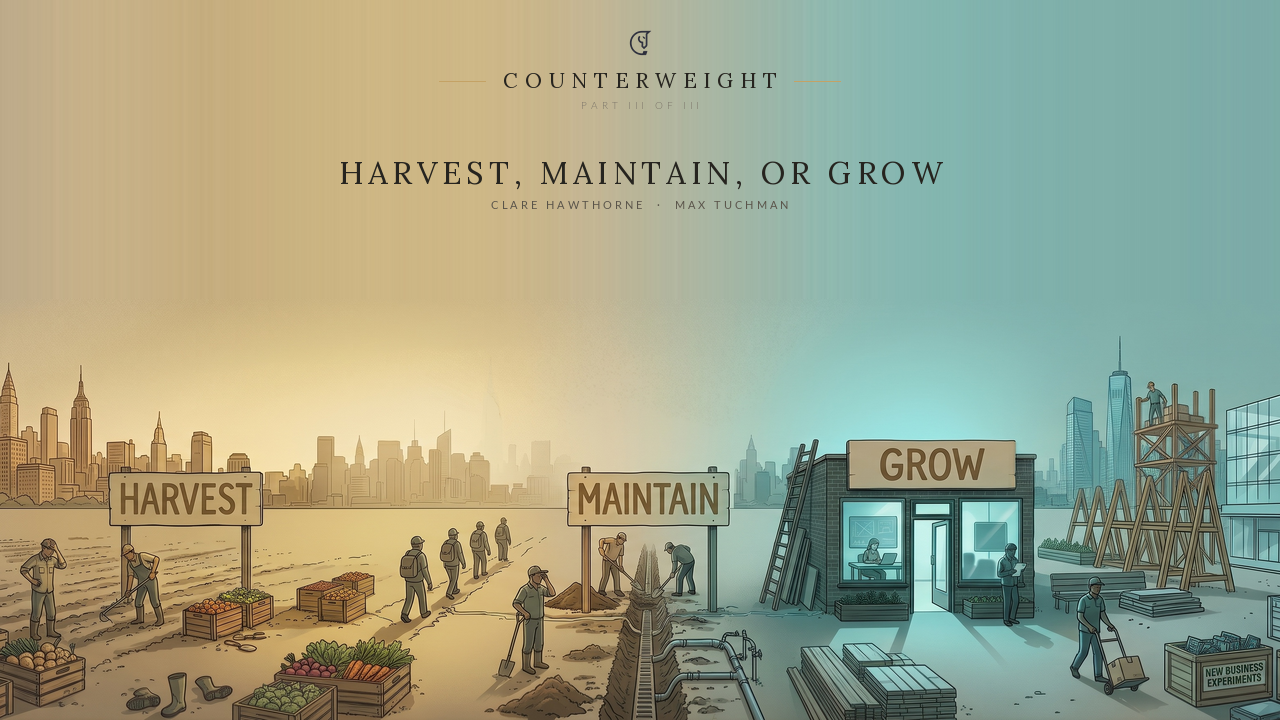
The choice breaks three ways. Harvest, maintain, or grow. Most organizations walk through one of those doors without ever saying they chose it.
Harvest
Harvest is cut heads, keep the output, bank the savings. It doesn't require vision. It requires a spreadsheet you already have.
Part of why it goes down easy is that the first thing people feel isn't a layoff. It's relief. Everyone has been doing a job and a half for years, and the early weeks of this mostly hand people back the one job they were actually hired for. That part is real. It's also the anesthetic.
Then the freed hours get converted into headcount math before anyone asks what else the company might attempt. Same roadmap, smaller team, savings booked in the quarter they show up.
Nobody has to be cynical for harvest to win. The spreadsheet is just faster than a strategy conversation.
Maintain
Maintain is the quieter cousin. Keep the headcount, and finally let the team do the rearchitecture and the cleanup that never made it onto a roadmap because nobody could justify the hours.
One of us had a client describe it as clearing the decks. Wipe enough tech debt that the team could stop living under keep-the-lights-on. Same heads, work that never made the cut. That's maintain.
We have both seen what one quarter of honest maintain does. The platform migration gets scoped. The integration debt gets a real owner. Nobody outside the team notices. It just makes next year less broken than this one.
Then the urgent work crowds it out again, because maintain never got named as a choice. It was just the thing that kept losing.
Grow
Grow is what actually changes what a company or a person attempts. Run the experiment. Prototype the thing that used to die at "huh, I wonder." Expand what you sell, what you build, what you ask your teams to try.
Clare: On a recent engagement, I vibe-coded a visualization for my own use while I did the advisory work. It wasn't in the scope letter. The client kept asking to see it. By the second week it was on every screen share.
I proposed a follow-on. A production-ready application, scoped properly, with ownership and maintenance settled up front. Somewhere in there it hit me. I hadn't just shipped a scratch tool. I had a new line of business, application development sitting next to the advisory work, which was never in my business plan.
The price of finding that out has collapsed. It will not stay collapsed.
Pick One on Purpose
In Part I, we disagreed about where this ends. In Part II, we agreed the window won't stay open. On this one we land in the same place: the technology isn't making this decision. Someone in your building is, probably this quarter, possibly without noticing.
Here's what keeps us from stopping at "AI gave us time back."
We're used to systems with a redistribution rule built in. Go around the board, collect $200. This one doesn't have one. Nothing sends the freed hours back around to the people who did the work. Somebody with a title has to look at that capacity and deal the card on purpose. This goes to a new experiment, not back to the bank.
Left to gravity, it goes back to the bank. Every time.
So the CFO doing the fastest math isn't wrong. Harvest is the rational move when nobody names an alternative out loud. Grow only happens because a specific person decided the freed hours were worth more spent than banked.
Harvest, maintain, or grow. You are going to pick one. The only question is whether you pick it, or gravity picks it for you.
Name it out loud. That's the whole ask.
About the Authors
Clare Hawthorne: I founded OxerLine Advisory to fix friction at the seam between technology and the business. If this is something you're facing, let's chat.
Max Tuchman: Runs Dark Horse Ops, private AI tutoring for executives and founders. She's a founder (Caribu, acquired by Mattel), former GM at Mattel, White House Fellow and high-school teacher. She now works with leaders 1:1 to move from chatting with AI to building real capacity with it.
A note on how this got written: AI assisted Clare and me in capturing our conversation and organizing our thoughts into three posts. The stories, the opinions, and the scars are all ours, but we work with very good robot assistants who help us get them out of our heads and onto the page.