Knowledge Workers Are the First Wave. Trades Are the Second. Your Plan Needs Both.
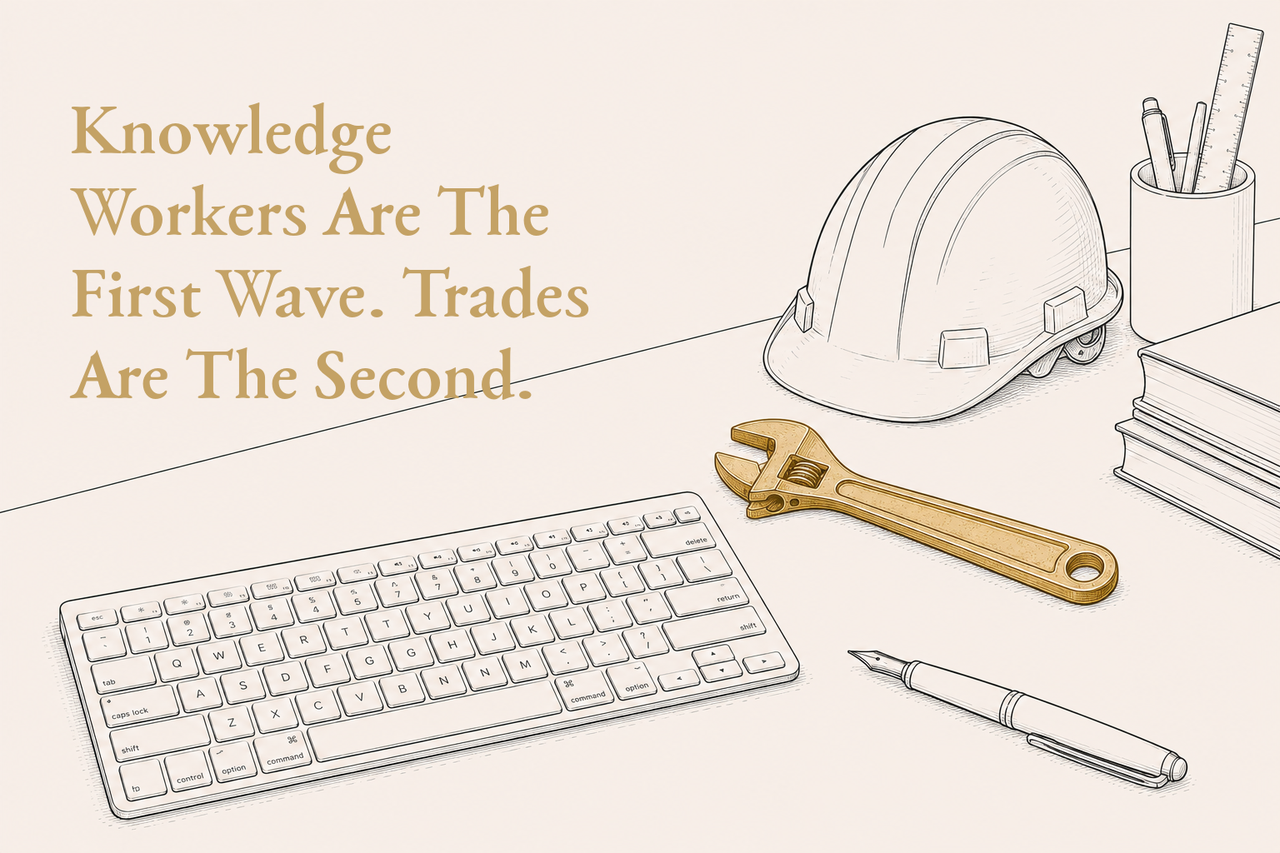
Most conversations about AI displacement assume a single wave. AI shows up. Some jobs go away. Everybody adjusts.
That framing is going to age poorly. There are two distinct waves coming, on different timelines, hitting different parts of your workforce, and they require different planning. Most executives are scrambling to plan for the first wave and have not started thinking about the second.
The first wave is already here. The second wave is closer than you think.
Wave One: Knowledge Work
The first wave is hitting knowledge workers. Anyone whose job is primarily research, writing, editing, formatting, analysis, document review, basic coding, or routine communication.
The pattern is clear in the data. AI is augmenting the work of senior knowledge workers and replacing the routine portion of work performed by junior employees. [1] The first jobs to go are not whole roles. They are the entry-level tasks inside knowledge roles. The first-year analyst tasks. The associate paralegal work. The basic copy editing.
That sounds like a small problem. It is not. The entry-level pipeline is how knowledge industries have produced senior talent for generations. If the bottom of the pyramid disappears, the top of the pyramid in fifteen years has nowhere to come from. Every executive whose company depends on knowledge work needs to be answering a question right now: how do you train the seniors of 2040 if there are no juniors in 2026?
This is not a 2030 problem. This is a today problem that will only feel like a problem in five years, which is exactly when it is too late to fix it.
Wave Two: Physical Work and the Trades
The second wave is humanoid robots, and the timeline is shorter than most boardrooms have priced in.
Industry analysts now project 50,000 to 100,000 humanoid robot shipments in 2026 alone, with unit costs dropping rapidly toward the $15,000 to $20,000 range as manufacturing scales. The same projections show 10 to 20 million units in deployment by the end of 2026 at cost parity with manual labor, and 50 million by 2027. [2]
This is no longer theoretical. Tesla has Optimus robots running at its Fremont factory. Figure AI has robots working shifts at BMW. Amazon has deployed Agility Robotics’ Digit robots in fulfillment centers. [2]
The implication is concrete. The trades that have felt safest from AI, plumbing, HVAC, manufacturing, warehouse logistics, surgical assistance, are the ones the second wave is aimed at directly. McKinsey Global Institute has estimated that automation, including humanoid robots and AI together, could displace between 400 and 800 million jobs worldwide by 2030. [2]
That is the same five-year window your knowledge work problem is operating on. Both waves are landing during the same strategic planning horizon.
Why Most Plans Address Only One Wave
The strategic plans I see in 2026 fall into one of three failure patterns.
The first pattern is plans that assume only knowledge work is at risk. These plans focus on AI adoption inside white-collar functions and treat the trades as the safe ground to retreat into. Robots are coming for that ground.
The second pattern is plans that assume only physical work is at risk. These plans focus on automating the warehouse and treat the corporate office as untouchable. The first wave is already eating that office.
The third pattern is plans that have not specified which wave they are addressing at all. These plans use the word “AI” without disambiguating between knowledge augmentation and physical automation. The two require different vendor relationships, different capital investments, different hiring strategies, and different timelines. Treating them as one problem produces a plan that solves neither.
What a Two-Wave Plan Looks Like
A real plan separates the two timelines and addresses each on its own terms.
For the knowledge wave, the plan covers which roles get augmented (most of them), which routine tasks get fully automated (the entry-level ones), how the talent pipeline gets rebuilt for a world where junior tasks are AI tasks, and how senior knowledge workers get retrained to use AI as the floor of their work rather than the ceiling.
For the physical wave, the plan covers which categories of physical work in your business will be done by robots within five years, what the capital expenditure looks like, which vendor relationships need to start now, what happens to the human workers in those roles, and what retraining or redeployment options exist.
A plan that does both is rare in 2026. It is also the plan that will look obvious in 2031.
The Harder Truth Most Leaders Avoid
The two waves are coming whether or not your plan addresses them. The technology does not wait for organizational readiness. The competitor across the street with the better plan is going to compound your strategic disadvantage every quarter you delay.
This is also not the kind of problem that gets solved by hiring an AI consultant for a six-week engagement. It is a multi-year operating shift that touches workforce, capital allocation, vendor strategy, and culture. It needs leadership ownership at the highest level of the company, not delegation to a chief AI officer who will leave in eighteen months.
The Question Worth Sitting With
Open your three-year strategic plan. Search the document for the words “knowledge worker.” Then search for “humanoid” or “robot.”
If neither word appears, your plan is not actually a plan for what is coming. It is a plan for the world you used to operate in.
Sources
[1] Anthropic, “Labor market impacts of AI: A new measure and early evidence.”
[2] Deloitte Insights, “Physical AI and humanoid robots,” 2026; The Robot Report, “IEEE survey sheds light on how AI and humanoids will affect robotics in 2026.”
For those of you warming up in the comments, yes, I obviously used AI to help me write this. That’s my whole point: the ideas are mine, drawn from a five-page free-flowing brain dump and from real conversations I’ve had with people at all ends of the AI knowledge spectrum. AI helped me organize, tighten, and get the words on the page faster than I could on my own. I have been telling you throughout this series that AI is not here to replace you, it is here to make you more efficient. This article is the proof.