The First Time in History Non-Technical People Can Compete at the Top of a Tech-Defined Arena
By the end of 2026, 80 percent of technology products and services will be built by non-IT professionals. [1] Citizen developers will outnumber professional developers four to one. [1]
Read those numbers slowly.
For the past forty years, building anything digital meant going through people who could code. Founders who could not code paid them, partnered with them, gave them equity, or did not build the thing at all. Executives who could not code accepted long timelines and high costs as the price of admission. Operators who could not code had ideas die at the brief.
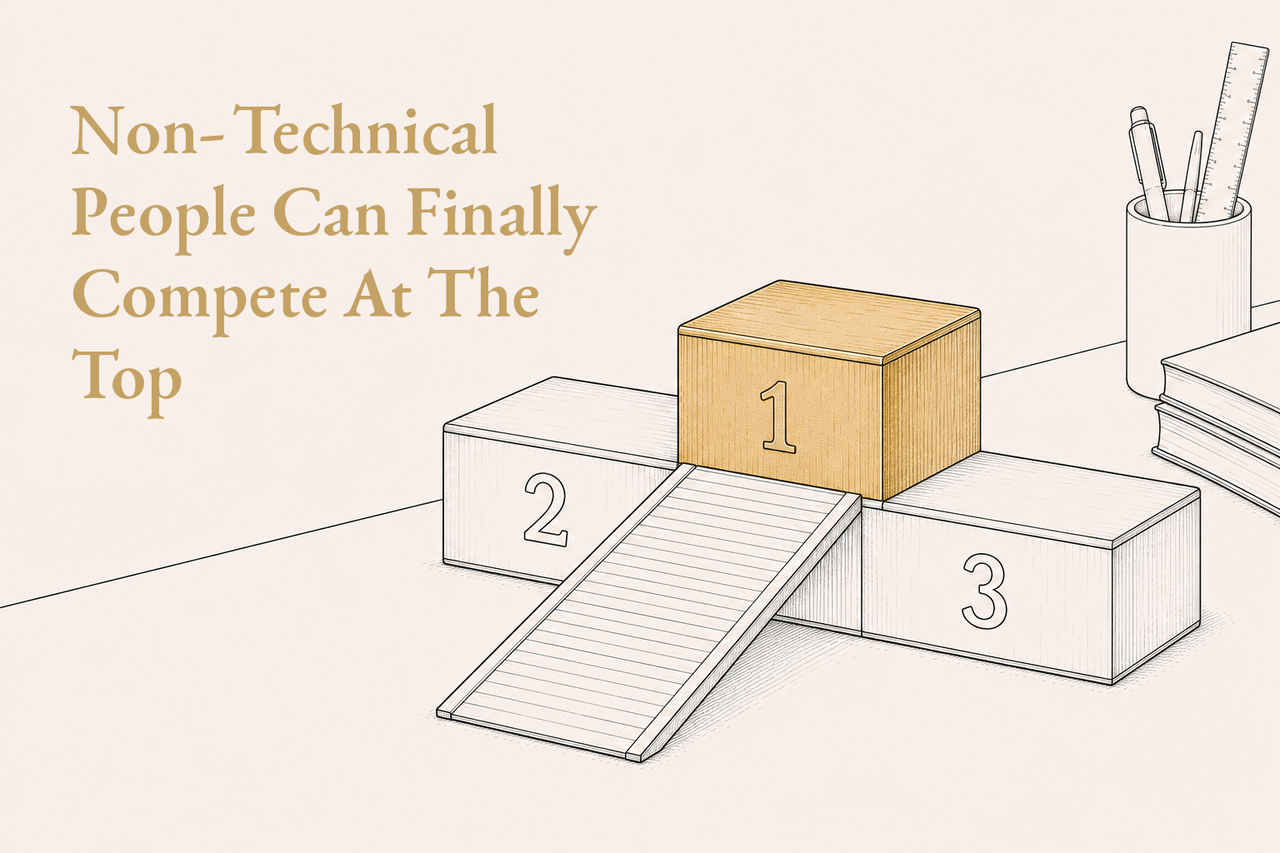
That world is ending. This is the first time in modern history when non-technical people can compete in a tech-defined arena without a technical co-founder, without an engineering team, and without the years of credentialing that the old gatekeepers required.
I want to make that statement concrete, because most non-technical leaders do not yet believe it.
What the Numbers Actually Say
The shift from credentialed builders to anyone-with-AI is documented.
Twenty-four percent of no-code and AI-building tool users reported they had no coding experience at all before they started. [1] These are people who two years ago could not have shipped a piece of software to save their lives. They are now running products in production.
What used to require a $100,000 development budget and a six-month timeline can now be built for under $350 a month in AI tool subscriptions, in days to weeks instead of months. [1] What used to require giving away 20 to 50 percent of a company to a technical co-founder can now be done while keeping 100 percent ownership. [1]
Those numbers are not from an AI tool’s marketing site. They are from industry tracking of where software is being built right now.
What This Changes About Who Gets to Play
The old playbook for non-technical operators went something like this. Have an idea. Recruit a technical co-founder. Give that person significant equity. Wait six months for an MVP. Hope the co-founder does not leave. Iterate slowly because every change requires the co-founder’s calendar.
The new playbook starts with the operator opening AI tools and trying to build a rough version of the idea themselves. The first version is messy. The second version is functional. By the third version, the operator has either validated the idea is real and now hires a technical person to scale it, or has discovered the idea was wrong and saved themselves a year of cofounder negotiations.
That single shift in sequence is the difference between non-technical operators being passive consumers of technology decisions and being the people driving them.
Why Most Non-Technical Executives Still Do Not Believe This
I run workshops with executives and their teams. The most common reaction the first time someone watches me build a working agent in twenty minutes is not excitement. It is grief.
Grief that this was possible while they were spending money on agencies that took six weeks. Grief that they could have shipped the product they had in their head three years ago. Grief that the people they assumed they had to defer to were not actually a hard constraint, just an expensive one.
The grief is appropriate. It also passes quickly when the executive realizes that the same shift that exposes the past mistake also opens the next opportunity. The arena has changed. The credentials that used to matter, matter less. The operators who can describe a system clearly in plain English, identify the actual business problem, and iterate on what they see, are now able to do work that previously required handing off to a credentialed engineer.
If you have ever run a P&L, mapped a customer journey, written a job description, or designed an org chart, you have already done harder cognitive work than what AI building requires. The new skill is just plain-English specification, applied with patience.
What This Does Not Mean
It does not mean every non-technical executive should now be building production systems. The serious technical work of running enterprise infrastructure still requires deep expertise. Anyone who tells you otherwise is selling something.
It does mean that the prototypes, the proofs of concept, the internal tools, the websites, the marketing automations, the data dashboards, the personal productivity agents, the small bets that used to require a developer’s calendar, are now in your hands. Anything that can be built and iterated on by one operator with judgment is now a one-operator job.
The dividing line between “things only engineers can build” and “things anyone with AI can build” is moving. Every quarter, more capability moves to the second category. The executives who notice the line moving stay competitive. The executives who do not notice are still on the side that needs an engineer for everything.
The Deeper Unlock
The deeper unlock is not the tools. The deeper unlock is the realization that the credentials you accepted as the cost of entry into this work are no longer the price.
Some of those credentials were always rationed for political reasons. Others were rationed because the technology genuinely could not be operated without them. Technology has changed. The political rationing is starting to look indefensible.
For non-technical women, people of color, and operators from non-traditional backgrounds who have spent careers being told they were not the right fit to build things in this space, this is a generational opening. It will not stay open forever. The platforms will eventually professionalize. The credentialing will reassert itself. But for the next several years, the door is unusually wide.
Walk through it.
The Question Worth Sitting With
What is one project on your roadmap that you currently cannot move forward on because you are waiting for technical resources?
What if you tried, this week, to build the first ugly version yourself?
You are not unqualified. You have just been told you were for so long that you started believing it.
Sources
[1] Adalo, “37 No-Code Market Growth Statistics Every App Builder Must Know,” 2026; CodeConductor, “No Code Statistics — Market Growth and Predictions,” 2026.
For those of you warming up in the comments, yes, I obviously used AI to help me write this. That’s my whole point: the ideas are mine, drawn from a five-page free-flowing brain dump and from real conversations I’ve had with people at all ends of the AI knowledge spectrum. AI helped me organize, tighten, and get the words on the page faster than I could on my own. I have been telling you throughout this series that AI is not here to replace you, it is here to make you more efficient. This article is the proof.