Seventy-nine percent of enterprises report adopting AI agents in some form. About eleven percent are actually running them in production. [1]
That sixty-eight point gap between "we have AI agents" and "we have AI agents that work" is the chasm I want to talk about.
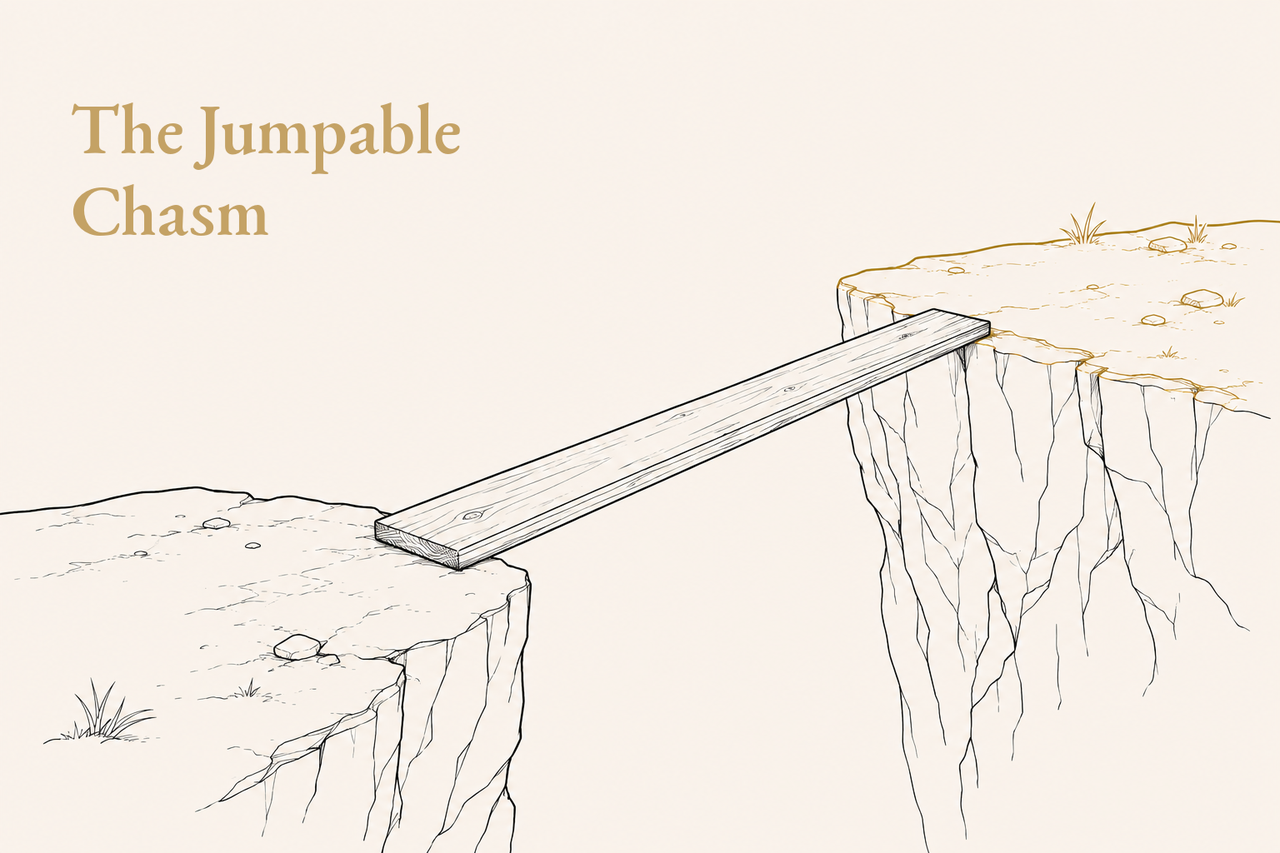
It is the chasm between chatting with AI and building with agents. Most organizations think they have crossed it because someone on the team is using ChatGPT. They have not crossed it. They are standing on the same side they were standing on a year ago, and the other side keeps getting further away.
This is the most important shift in your AI strategy right now, and almost nobody on your leadership team is naming it.
What the Chasm Actually Is
A chat conversation with AI is a question and an answer. You ask. The model answers. You ask again. You copy something into something else. The transaction begins and ends at your keyboard.
An agent is different. An agent is a workflow you assemble where AI takes actions on its own. It pulls data from your calendar, drafts a follow-up, checks a spreadsheet, sends a Slack message, schedules a meeting, summarizes the result, and delivers it to you finished. You designed the path. The agent walks it. While you are doing something else.
The chat user trades minutes for an answer. The agent builder trades a one-time setup for a process that runs forever. Compounding returns versus linear returns. That is the entire economic argument for crossing the chasm.
McKinsey estimates that AI agents could add $2.6 to $4.4 trillion in value annually across business use cases. [2] None of that value lives on the chat side of the chasm.
Why People Are Frozen at the Edge
In every workshop I run, the same sentence comes out of someone's mouth in the first ten minutes: "I'm not technical enough to build an agent."
That sentence was true in 2015. It was true in 2020. It is no longer true in 2026.
The current generation of agent-building tools is designed for someone who understands their own work, not for someone who can write Python. If you can describe a process clearly in plain English, you can build an agent that runs it. The "technical" part of the job is the thinking about what the process should be. The actual building is conversation.
The reason most executives stay frozen at the edge of the chasm is not that they cannot cross it. It is that they have been told for a decade that the other side is for engineers. That story stopped being true. The story has not updated in their heads.
There is also a vendor problem on the other side of the chasm. Gartner identified a widespread trend it calls "agent washing," where vendors rebrand existing chatbots and RPA tools as "agentic AI" without delivering true agentic capabilities. Of the thousands of vendors claiming agentic solutions, Gartner estimates only about 130 actually offer genuine agentic features. [3]
If you have not built one yourself, you cannot tell the real ones from the wrappers. That is how a $300,000 line item ends up on your budget for a tool your team will abandon in five months.
The Only Way Across Is to Build Something
You cannot watch your way across this chasm. You cannot listen your way across. You cannot read a McKinsey report or a LinkedIn post that gets you across.
The chasm is jumped by getting your hands dirty.
Pick a small, annoying task on your calendar this week. Pick something nobody else will notice if you do it badly. Use whatever tool is at your disposal and try to build an agent that does the task. Watch what works. Watch what breaks. Fix one thing. Try again.
That is the entire onboarding curriculum. Most of my coaching clients cross the chasm in their first two weeks of doing this consistently. Those who try to read their way across are still trying eight weeks later.
The Clock That Compounds
Every week you stay on the chat side of the chasm, the build side gets further away. Not because the chasm widens, but because the other side moves. The tools improve exponentially. The people on the build side get more sophisticated. The work they produce gets better.
Gartner predicts that 33 percent of enterprise software applications will include agentic AI by 2028, up from less than 1 percent in 2024. The reader who decides to start building this Monday will be three weeks behind the reader who started last Monday. The reader who decides to start in October will be six months behind, and the gap will be effectively un-closeable.
This is not me selling urgency. This is me reading a graph.
The Question Worth Sitting With
Look back at the last seven days. Be honest about what you actually did with AI.
Did you build something? Or did you just chat?
Sources
[1] Ampcome, "Enterprise AI Agents 2026: Mid-Year Report on What's Working."
[2] McKinsey & Company, "State of AI trust in 2026: Shifting to the agentic era," 2026.
[3] Gartner, "Gartner Predicts Over 40% of Agentic AI Projects Will Be Canceled by End of 2027," June 25, 2025.
For those of you warming up in the comments, yes, I obviously used AI to help me write this. That's my whole point: the ideas are mine, drawn from a five-page free-flowing brain dump and from real conversations I've had with people at all ends of the AI knowledge spectrum. AI helped me organize, tighten, and get the words on the page faster than I could on my own. I have been telling you throughout this series that AI is not here to replace you, it is here to make you more efficient. This article is the proof.